
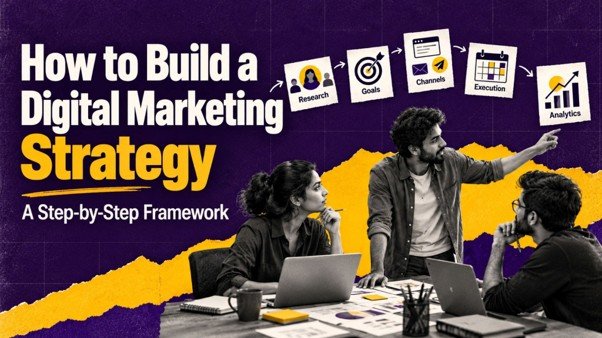
Many businesses do lots of marketing but have no marketing strategy. They post on Instagram because everyone does, run ads because a competitor does and start a blog because someone said SEO is important. Activity is high, results are unclear and money leaks away.
A digital marketing strategy changes that. It is a clear plan that connects business goals to specific audiences, messages, channels, budgets and measurements. It tells you what to do, why, in what order and how you will know if it is working.
This guide gives you a practical, step-by-step framework to build a digital marketing strategy for any business, whether it is your own brand, an employer or a client.
Strategy vs Tactics: What Is the Difference?
• Strategy is the overall plan: who you target, what you offer them, why they should choose you and which broad approaches you will use.
• Tactics are the specific actions: a reel, a Google Ads campaign, a blog post or an email sequence.
Tactics without strategy create noise. Strategy without tactics creates documents that nobody follows. You need both, in that order.
Step 1: Start With Business Goals
Marketing exists to serve business objectives. Begin by clarifying them:
• Increase revenue by a specific amount
• Generate a certain number of qualified leads each month
• Launch a new product successfully
• Expand into a new city or customer segment
• Improve customer retention
Convert business goals into SMART marketing objectives: Specific, Measurable, Achievable, Relevant and Time-bound. For example: “Generate 60 qualified enquiries per month from Noida and Greater Noida within six months.”
Step 2: Understand Your Audience Deeply
Strategy depends on understanding customers. Use research to define:
• Who they are
• What problems they face
• What they want to achieve
• What objections they have
• Where they look for information
• What triggers them to buy
Build two or three buyer personas. If you have not done this yet, follow our guide to market research for marketers.
Step 3: Analyse Your Current Situation
Before deciding where to go, understand where you are.
Audit Current Marketing
• Website traffic, conversion rates and top pages
• Search rankings and keywords
• Social media performance
• Email list size and engagement
• Ad performance and costs
• Reviews and reputation
Run a SWOT Analysis
• Strengths: what you do better than others
• Weaknesses: gaps that hold you back
• Opportunities: trends, underserved audiences, competitor gaps
• Threats: competitors, rising costs, market changes
Our guide to marketing analytics for beginners explains how to read the numbers for your audit.
Step 4: Define Your Positioning
Positioning is the place you want to occupy in your customer’s mind. A strong positioning statement answers:
• For (target customer)
• Who (need or problem)
• We are (category)
• That (key benefit)
• Unlike (alternatives)
• Because (proof or reason to believe)
Example: “For small clinic owners who struggle to get consistent patient enquiries, we are a local marketing partner that delivers measurable appointment growth, unlike generic agencies, because we specialise in healthcare SEO and Google Maps optimisation.”
Positioning guides every message you create. See copywriting for digital marketers for turning it into words.
Step 5: Map the Customer Journey
Customers move through stages before buying:
1. Awareness: they realise they have a problem
2. Consideration: they explore options
3. Decision: they choose a provider
4. Retention: they become repeat customers
5. Advocacy: they recommend you
Plan what content, channels and messages serve each stage. Our marketing funnel guide explains this in depth.
Step 6: Choose Your Channels
Choose channels based on where your audience spends time, your goals, budget and team capacity. Do fewer channels well rather than many channels poorly.
| Goal | Channels That Often Fit |
| Local enquiries | Google Business Profile, local SEO, Google Search Ads |
| Long-term traffic | SEO, content marketing, YouTube |
| Fast leads | Google Search Ads, Meta lead campaigns |
| Brand awareness | Instagram, YouTube, influencer partnerships |
| B2B leads | LinkedIn, SEO, email, webinars |
| Retention | Email, WhatsApp, loyalty programmes |
Most strategies combine organic and paid channels. See organic vs paid marketing and Google Ads vs Meta Ads.
Step 7: Plan Content and Messaging
For each persona and funnel stage, decide:
• Key messages and proof points
• Content formats (blogs, reels, guides, case studies, emails, ads)
• Topics based on customer questions and keyword research
• Publishing frequency
• Who creates and approves content
Create a simple content calendar for the next three months.
Step 8: Set Your Budget
Allocate budget across:
• Paid advertising
• Content creation (writing, design, video)
• Tools and software
• Website improvements
• People (team, freelancers or agencies)
Start with tests. Allocate a portion of the budget to experiments, then scale what works. Plan for ramp-up time with SEO and content.
Step 9: Define KPIs and Measurement
Choose key performance indicators for each objective:
• Awareness: reach, impressions, branded search volume
• Engagement: engagement rate, time on site, video views
• Conversion: leads, conversion rate, cost per lead, sales
• Revenue: ROAS, revenue, customer acquisition cost
• Retention: repeat purchase rate, customer lifetime value
Set up tracking before launching campaigns, and decide how often you will review results.
Step 10: Create an Action Plan and Timeline
Turn the strategy into a 90-day plan:
• Month 1: fix foundations (website, tracking, Google Business Profile), launch core content and initial tests
• Month 2: expand content, optimise campaigns, start email nurturing
• Month 3: scale winners, cut losers, review results and plan the next quarter
Assign owners and deadlines to every action.
Step 11: Review, Learn and Adjust
A strategy is a living document. Review monthly: – What worked and why? – What did not work and why? – What did we learn about customers? – What should we change next month?
A One-Page Strategy Template
You can summarise your strategy on one page:
1. Business goal:
2. Marketing objectives (SMART):
3. Target personas:
4. Positioning statement:
5. Key messages:
6. Priority channels:
7. Content plan summary:
8. Budget allocation:
9. KPIs and targets:
10. 90-day action plan:
11. Review schedule:
Common Strategy Mistakes
• Starting with channels instead of goals and audiences
• Trying to be everywhere at once
• Copying competitors’ tactics without understanding their strategy
• Setting vague goals like “increase awareness”
• Ignoring the website and conversion experience
• Not allocating time for testing and learning
• Never reviewing or updating the plan
Strategy in the OPM Engineer Programme
Strategy is the third pillar of VisionaryCue’s OPM Engineer programme, built on research and analysis and feeding into structure planning, communication, design, development, marketing and advertising. Learners create real strategies for their own brand projects and for client acquisition. Explore the full curriculum and see why OPM differs from channel-only courses.
A Worked Example: Strategy for a New Café
Business goal: Reach consistent weekday footfall within six months of opening.
Objective: Generate a steady flow of weekday visits and table bookings from residents and office workers within a two-kilometre radius.
Audience research: Office workers want quick, reliable lunches and a quiet place for meetings; residents want a relaxed evening spot and weekend brunch.
Positioning: “The neighbourhood café where weekday lunches are fast and weekends are slow.”
Channels: – Google Business Profile with photos, menu, hours and regular posts – Instagram with reels of dishes, behind-the-scenes and community moments – Small Meta campaigns targeting nearby offices with a weekday lunch offer – WhatsApp list for regulars with weekly specials
Content plan: Lunch combos on weekdays, brunch content on weekends, customer stories and staff introductions.
KPIs: Google profile calls and direction requests, Instagram reach in the local area, offer redemptions, repeat visits from the WhatsApp list.
90-day plan: Month one focuses on profile setup and launch content; month two tests offers and targeting; month three scales the best offer and builds the loyalty list.
This example shows how each element of the framework flows into the next, producing a focused, measurable plan instead of scattered activity.
Presenting a Strategy to Stakeholders
A great strategy still needs buy-in. When presenting to a manager, founder or client:
• Start with the goal and the problem, not the tactics.
• Show the evidence from research and analysis that supports your recommendations.
• Explain trade-offs, including what you recommend not doing and why.
• Be specific about budget, timeline and expected outcomes.
• Define how success will be measured and when you will review it.
• Keep it short, with supporting details in an appendix.
Clear, evidence-based presentations build confidence and make approval far easier.
Adapting Strategy for Different Business Types
Local service businesses: focus on Google Business Profile, local SEO, reviews, search ads and WhatsApp follow-up.
Ecommerce and D2C brands: focus on product pages, social discovery, influencer partnerships, retargeting, email and retention.
B2B companies: focus on LinkedIn, thought leadership content, SEO, webinars, case studies and longer nurture sequences.
Education businesses: focus on seasonal admission campaigns, results-based proof, parent-focused messaging and demo classes.
Startups: focus on rapid testing to validate messaging and channels before scaling.
The framework stays the same; the emphasis shifts based on how customers in each category discover and decide.
Strategy Review Questions for Every Quarter
• Are we still targeting the right audience?
• Has competition or the market changed?
• Which channels delivered the best return?
• Which assumptions turned out to be wrong?
• Is our positioning still clear and differentiated?
• Do we need to adjust budget allocation?
• What new opportunities have emerged?
Answering these questions regularly keeps your strategy relevant as conditions change.
Strategy for Personal Projects and Freelancers
The same framework works when the “business” is you. If you are a freelancer or job seeker, your goal might be landing three retainer clients or a first marketing role. Your audience is the business owners or recruiters you want to reach. Your positioning is the specific value you offer. Your channels might be LinkedIn, referrals and a portfolio website. Your KPIs could be conversations started, proposals sent and offers received. Applying strategic thinking to your own career is excellent practice and often delivers faster results than scattered effort.
Your Action Checklist
Use this checklist to put the ideas in this guide into practice over the next few weeks. Tick each item off as you go, and revisit the list whenever you feel stuck or unsure what to do next:
• ☐ Write one SMART marketing objective.
• ☐ Summarise your top persona in five lines.
• ☐ Draft a positioning statement.
• ☐ Choose no more than three priority channels.
• ☐ Allocate a test budget.
• ☐ Define KPIs for each objective.
• ☐ Create a 90-day action plan with owners.
• ☐ Schedule monthly reviews.
Working through these steps consistently will turn the concepts in this article into real skills, measurable results and material you can proudly add to your portfolio.
Start small, stay focused and refine as you learn.
Key Takeaways
• Strategy connects business goals to audiences, positioning, channels, budgets and measurement.
• Start with goals and customers, not with channels or tactics.
• Clear positioning guides every message and creative decision.
• Choose fewer channels and execute them well, combining organic and paid where sensible.
• Turn strategy into a 90-day action plan and review it monthly.
Final Thoughts
A digital marketing strategy brings focus, efficiency and accountability to marketing. By starting with goals, understanding customers, defining positioning, mapping the journey, choosing channels wisely and measuring results, you create a plan that guides every action and improves over time.
Ready to learn strategy hands-on with real projects? Book a free consultation or explore the OPM Engineer pricing.
Frequently Asked Questions (FAQs)
1. What is a digital marketing strategy?
A plan that connects business goals to target audiences, positioning, channels, content, budget and measurement.
2. What is the difference between strategy and tactics?
Strategy is the overall plan and direction; tactics are specific actions like posts, ads or emails that carry out the strategy.
3. What should a digital marketing strategy include?
Goals, audience personas, situation analysis, positioning, customer journey, channels, content plan, budget, KPIs and an action timeline.
4. How long should a marketing strategy cover?
Many businesses plan annually with detailed 90-day action plans that are reviewed monthly.
5. What are SMART goals?
Goals that are Specific, Measurable, Achievable, Relevant and Time-bound.
6. How do I choose the right marketing channels?
Choose based on where your audience spends time, your goals, budget, team capacity and the funnel stage you need to serve.
7. What is positioning in marketing?
Positioning defines how you want customers to perceive your brand relative to alternatives, based on a key benefit and proof.
8. How much should a small business spend on marketing?
It varies by industry, goals and margins. Start with focused tests and scale spending on what proves profitable.
9. How often should a marketing strategy be reviewed?
Review performance monthly and update the strategy at least quarterly or when market conditions change.
10. Can I create a marketing strategy without a big budget?
Yes. Strategy is about focus and smart choices, which matter even more with limited budgets.
11. What is a SWOT analysis?
A framework that examines strengths, weaknesses, opportunities and threats to inform strategic decisions.
12. Is strategy taught in the OPM Engineer programme?
Yes. Strategy is the third of nine pillars, with practical exercises for brand and client projects.