
Google Ads vs Meta Ads: Which Is Better for ROI?
When businesses evaluate paid traffic channels, the biggest debate is Google Ads vs Meta Ads. Both platforms dominate digital advertising, but they operate on fundamentally different principles. If your goal is maximizing return on investment, understanding how each platform drives conversions is critical.
In this guide, we’ll break down Google Ads vs Meta Ads from an ROI perspective, comparing intent, targeting, cost structure, scalability, and funnel positioning so you can decide which platform aligns best with your business goals.
Understanding the Core Difference
At its core, Google Ads captures demand while Meta creates demand.
Google operates primarily on intent-based advertising. Users search for a product or service, and your ad appears when their query matches your keywords. This makes it a strong player in the PPC vs social media ads debate because it targets users who are actively looking to buy.
Meta platforms, including Facebook and Instagram, rely on interest and behavior-based targeting. Users are not necessarily searching for your product, but the algorithm identifies those most likely to engage based on demographics, interests, and past activity.
This difference shapes how Google Ads vs Meta Ads perform across different industries.
ROI From High-Intent Traffic
Google excels when users have clear buying intent. For example, someone searching “best CRM software for small business” is already deep in the decision stage.
Because of this high intent, conversion rates on Google Search campaigns are often higher. While cost per click can be more expensive, the quality of traffic tends to justify the investment. In a comparison of Google Ads vs Meta Ads, Google often wins for bottom-of-funnel conversions.
Service-based businesses, local companies, and B2B brands frequently see stronger direct ROI from Google due to keyword-driven targeting.
ROI From Audience Targeting and Discovery
Meta thrives in awareness and consideration stages. Its algorithm identifies users who resemble your existing customers and introduces your offer visually through engaging creatives.
This is where PPC vs social media ads becomes a strategic conversation rather than a simple comparison. Social media advertising allows storytelling, brand building, and impulse-driven purchases.
For ecommerce brands with visually appealing products, Meta often delivers strong returns through creative-driven campaigns. In the discussion of Google Ads vs Meta Ads, Meta typically performs better for brand discovery and cold traffic scaling.
Cost Structure and Efficiency
Google Ads typically operates on a cost-per-click model, especially within Search campaigns. Competitive industries can drive high keyword bids, increasing acquisition costs.
Meta, on the other hand, often works with cost-per-impression models, meaning advertisers pay to show ads rather than for direct clicks. However, strong creatives can significantly lower cost per acquisition over time.
When evaluating Google Ads vs Meta Ads, your niche competitiveness and creative strength heavily influence ROI outcomes.
Creative vs Keyword Strategy
Google requires keyword research, landing page optimization, and strong alignment between search queries and ad copy. Performance improves with precise targeting and quality score optimization.
Meta requires compelling visuals, scroll-stopping hooks, and persuasive messaging. Creative testing becomes the main driver of success.
In many campaigns, businesses test Google Ads vs Instagram Ads specifically when deciding between search-based traffic and visually driven social placements. Instagram can generate high engagement, but without strong creatives, performance declines quickly.
Funnel Positioning
Google dominates the bottom of the funnel. It captures users ready to act. Meta dominates the top and middle of the funnel by building awareness and retargeting warm audiences.
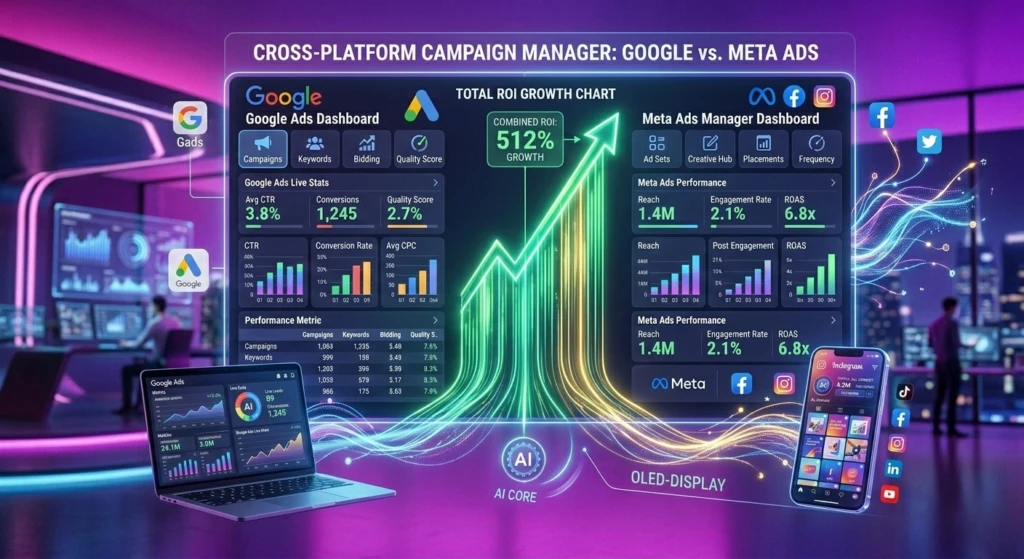
The smartest advertisers don’t treat Google Ads vs Meta Ads as an either-or decision. Instead, they combine both platforms strategically:
- Use Meta for awareness and engagement
- Retarget visitors using Google Display
- Capture high-intent searches with Google Search
- Reinforce messaging across social platforms
This omnichannel approach typically produces the strongest overall ROI.
Industry-Specific Considerations
Local services such as plumbers, lawyers, or dentists often see better direct ROI from Google due to urgent search behavior.
Ecommerce fashion, beauty, and lifestyle brands frequently scale faster on Meta due to visual appeal and impulse buying behavior.
In SaaS and B2B sectors, Google tends to generate higher-quality leads, though Meta can reduce overall acquisition costs when retargeting is optimized.
The effectiveness of Google Ads vs Meta Ads ultimately depends on your customer journey.
Which Platform Is Better for ROI?
There is no universal winner in the Google Ads vs Meta Ads debate. The better platform depends on:
- Your product type
- Customer buying behavior
- Sales cycle length
- Creative resources
- Budget size
If immediate intent exists, Google often produces faster returns. If demand needs to be generated, Meta may outperform.
For many brands, combining both platforms delivers the highest total return on ad spend.
Final Verdict
When comparing Google Ads vs Meta Ads, think in terms of strategy rather than competition. Google captures existing demand. Meta builds new demand. One targets intent, the other targets interest.
If your goal is sustainable growth, the real advantage comes from understanding how to position each channel within your marketing funnel. Instead of asking which is better, ask how both can work together to maximize ROI.