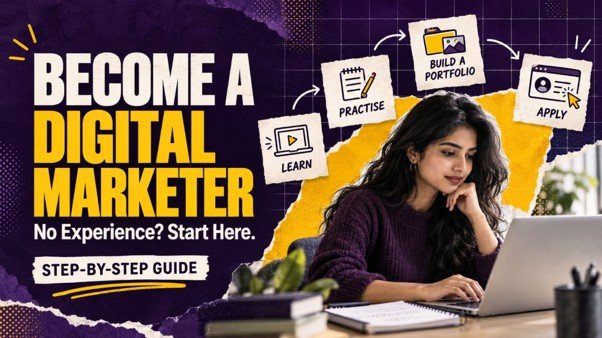
Every job listing seems to ask for experience, but how do you get experience if nobody gives you a chance? This frustrating loop stops many talented people from entering digital marketing.
Here is the good news: digital marketing is one of the few careers where you can create your own experience. You do not need permission to start a blog, grow a social media page, help a local business with Google Maps or run a small ad campaign. With the right plan, you can build real skills and proof of results before your first interview.
This guide gives you a practical, step-by-step plan to become a digital marketer with no prior experience, whether you are a student, a fresher or someone switching careers.
Step 1: Understand What Digital Marketing Really Is
Before diving into tools, understand the big picture. Digital marketing is the process of attracting the right people online, convincing them to take action and keeping them coming back. It includes:
• Research: understanding customers, competitors and markets
• Strategy: deciding goals, audiences, channels and messages
• Content and communication: creating messages that resonate
• Channels: SEO, social media, email, WhatsApp, paid ads and more
• Websites and funnels: the journey from first click to purchase
• Analytics: measuring what works and improving it
Many beginners jump straight into “how to run Instagram ads” without understanding why. Learning the full system, the idea behind Organic Performance Marketing, helps you make better decisions and stand out from people who only know one tool.
Step 2: Learn the Fundamentals in a Structured Way
Free videos and blogs are useful, but random learning often leaves gaps. A structured learning path helps you build skills in the right order and practise along the way.
When choosing how to learn, look for:
• A curriculum covering strategy as well as execution
• Practical assignments and live projects
• Mentorship and doubt-clearing support
• Exposure to real tools such as Google Analytics, Search Console, Meta Ads Manager and Google Ads
• Guidance on portfolios and career preparation
Our guide on how to choose a digital marketing course includes a checklist you can use to compare options.
Step 3: Pick a Starting Focus (But Stay Curious)
Digital marketing is broad. While it is valuable to understand everything, it helps to start with one or two areas where you can quickly produce results:
• Love writing? Start with content marketing and SEO.
• Enjoy visuals and trends? Start with social media and design.
• Like numbers and experiments? Start with paid ads and analytics.
• Interested in business? Start with strategy and local business marketing.
Over time, expand into other areas. Employers and clients increasingly value marketers who can connect channels together. See our list of essential digital marketing skills.
Step 4: Create Your Own Practice Projects
This is where you start building experience on your own terms.
Start a Blog or Niche Website
Choose a topic you know or enjoy, such as fitness, travel, personal finance or technology. Write helpful articles, learn keyword research and track your rankings in Google Search Console. This teaches SEO, content and analytics.
Grow a Social Media Page
Create an Instagram, LinkedIn or YouTube presence around a niche. Experiment with content formats, posting times and hooks. Track what grows engagement.
Run a Small Ad Campaign
With a small budget, promote your blog, page or a friend’s product. Learn targeting, creatives, budgets and reporting. Even a modest campaign teaches more than hours of theory.
Build Email or WhatsApp Lists
Offer a free resource and collect subscribers. Learn how to nurture an audience.
Document everything: goals, actions, screenshots and results.
Step 5: Help Real Businesses
Real-world projects carry more weight than personal experiments. Approach:
• Family or friends’ businesses
• Local shops, cafés, clinics and tutors
• NGOs and community organisations
• Student clubs and college events
Offer specific, small projects such as optimising a Google Business Profile, improving Instagram content for a month or setting up basic analytics. Agree clear goals so you can measure results. Early projects may be free or low-paid; the real payment is experience, testimonials and portfolio material.
Step 6: Earn Recognised Certifications
Certifications show commitment and basic knowledge. Useful options include certifications from Google (Analytics, Ads), Meta (Blueprint) and HubSpot (inbound and content marketing). Many are free.
Remember: certifications open doors, but results keep them open. Always pair certificates with practical work.
Step 7: Build a Portfolio That Proves Your Skills
Your portfolio is your experience when you do not have job history. Include:
• A short introduction about you and your focus areas
• Three to five case studies with the problem, what you did and the results
• Samples of content, ads, designs or reports
• Certifications and testimonials
Use simple tools such as a personal website, a Notion page or a PDF. Read our full guide on building a digital marketing portfolio.
Step 8: Get On-the-Job Experience
Internships, apprenticeships and on-the-job training programmes help you experience deadlines, client expectations, teamwork and real budgets. These are the moments where theory becomes skill.
The OPM Engineer programme at VisionaryCue includes on-the-job training in months four and five, followed by support towards a first project, subject to eligibility and programme terms. You can see how the months are structured on the programme timeline.
Step 9: Build Your Personal Brand
Share what you learn on LinkedIn: case studies, lessons, tools, mistakes and small wins. Recruiters and potential clients notice people who consistently show their thinking. Our guide on personal branding on LinkedIn for marketers walks you through it.
Step 10: Apply Smartly and Prepare for Interviews
• Tailor your resume to each role, highlighting relevant projects and results
• Include links to your portfolio and LinkedIn
• Research each company’s current marketing before interviews
• Prepare to explain your projects clearly: goal, approach, result, learning
• Practise common interview questions and simple practical tasks
See our guide on digital marketing resume and interview tips.
A Sample 6-Month Learning Plan
| Month | Focus | Outcome |
| 1 | Marketing fundamentals, research and strategy | Understand the full system |
| 2 | Content, copywriting, design basics and SEO | Start a blog or social page |
| 3 | Social media, email and analytics | Track results with GA4 and Search Console |
| 4 | Paid ads basics and landing pages | Run a small campaign |
| 5 | Real client or internship project | Measurable results and testimonial |
| 6 | Portfolio, personal brand and job or client search | Ready to apply or freelance |
This structure closely mirrors how practical programmes like OPM Engineer progress from theory to real work.
Common Mistakes Beginners Make
• Collecting courses without practising. Knowledge without application fades.
• Chasing tools instead of fundamentals. Tools change; principles last.
• Waiting to feel “ready.” Start projects early and learn by doing.
• Not tracking results. Without numbers, you cannot prove impact.
• Ignoring communication skills. Explaining your work clearly matters as much as doing it.
• Comparing yourself with experts. Focus on progress, not perfection.
How Long Does It Take?
With consistent effort, many beginners become ready for entry-level roles or small freelance projects within about six months. The timeline depends on how much time you invest, how quickly you start practical projects and how well you document results.
Daily and Weekly Habits That Accelerate Learning
Consistency matters more than intensity. A sustainable routine might look like this:
Daily (45–90 minutes): – 20 minutes of structured learning from your course or programme – 20 minutes of hands-on practice, such as writing, editing or optimising – 10 minutes studying good marketing in the wild: ads, landing pages and posts that catch your attention – 10 minutes engaging on LinkedIn with marketers and businesses in your niche
Weekly: – Publish at least one piece of content on your own blog or social page – Review your analytics and note one learning – Complete one practical assignment or project task – Reach out to one potential project, such as a local business or NGO – Update your portfolio notes with progress and screenshots
Small, repeated actions compound. After six months of this routine, you will have dozens of practical experiences, a growing audience, measurable results and a portfolio that speaks for itself.
Choosing Your First Practice Business Wisely
When you look for real businesses to practise with, choose carefully. The best early projects share a few traits:
• The owner is responsive. You need quick access to information, photos and approvals.
• There is a clear, measurable goal, such as more calls, enquiries or bookings.
• The current online presence is weak, so improvements are visible quickly.
• The business serves local customers, which makes Google Business Profile and local social media effective with small budgets.
• You can access data, such as Google Business Profile insights, Instagram analytics or website analytics.
Set expectations clearly before starting: what you will do, for how long, what you need from the owner and how results will be measured. Treat these practice projects with full professionalism; they often turn into paid work or strong referrals.
Resources That Help Beginners Learn Faster
Alongside structured training, a few habits and resources make a big difference:
• Official platform help centres: Google, Meta and other platforms publish detailed, up-to-date guides.
• Free certifications: structured paths from Google, Meta and HubSpot cover fundamentals.
• Industry newsletters and blogs: follow a handful of reliable sources rather than dozens.
• Ad libraries: the Meta Ad Library shows real ads from brands in any industry.
• Search Console and GA4 demo accounts: practise reading real data before you have your own.
• Communities: marketing groups on LinkedIn and other platforms help you ask questions and find opportunities.
• Mentors: one experienced marketer reviewing your work can save months of trial and error.
Be selective. Too many resources can overwhelm you. Choose a few, go deep and apply what you learn immediately.
Signs You Are Ready for Your First Role
You are likely ready to apply or take freelance work when you can:
• Explain how a marketing funnel works using a real example
• Set up basic tracking and read a GA4 report
• Write a clear ad and landing page headline
• Run a small campaign and explain its results
• Show at least three documented projects
• Talk confidently about what you learned from mistakes
You will never feel completely ready. If you can tick most of these boxes, start applying while you keep learning.
Your Action Checklist
Use this checklist to put the ideas in this guide into practice over the next few weeks. Tick each item off as you go, and revisit the list whenever you feel stuck or unsure what to do next:
• ☐ Choose your starting focus area.
• ☐ Set up a blog or niche social page.
• ☐ Pick one local business to help.
• ☐ Schedule daily learning and practice time.
• ☐ Create a portfolio document and add your first notes.
• ☐ Sign up for one free certification.
• ☐ Share your first learning post on LinkedIn.
Working through these steps consistently will turn the concepts in this article into real skills, measurable results and material you can proudly add to your portfolio.
Key Takeaways
• You can create your own experience through blogs, social pages, small ad campaigns and local business projects.
• Learn the full marketing system first, then build depth in one or two areas.
• Certifications help, but measurable results and a strong portfolio matter more.
• On-the-job training bridges the gap between theory and professional work.
• Share your journey on LinkedIn to attract opportunities.
Final Thoughts
Becoming a digital marketer with no experience is absolutely possible. Learn the fundamentals, practise on your own projects, help real businesses, document results, earn certifications, build a portfolio and share your journey. Within months, you will have something more powerful than a line on a resume: proof that you can deliver.
If you would like a structured path with mentorship, real projects and on-the-job training, explore the OPM Engineer curriculum or book a free consultation.
Frequently Asked Questions (FAQs)
1. Can I become a digital marketer without any experience?
Yes. You can build experience through personal projects, local business work, internships and structured training before your first job.
2. Do I need a marketing degree to become a digital marketer?
No. Practical skills, results and a portfolio matter more than a specific degree.
3. What should I learn first in digital marketing?
Start with fundamentals: understanding customers, strategy, content and basic analytics. Then explore channels like SEO, social media and ads.
4. How can I get experience in digital marketing?
Start a blog or social page, help local businesses, volunteer for NGOs, run small campaigns and pursue internships or on-the-job training.
5. How long does it take to become job-ready?
With consistent learning and practice, many beginners become ready for entry-level roles in around six months.
6. Are free courses enough to learn digital marketing?
Free resources are helpful, but structured courses with practical projects and mentorship usually help you progress faster and avoid gaps.
7. What certifications should beginners get?
Google Analytics, Google Ads, Meta Blueprint and HubSpot certifications are popular, credible options.
8. What should a beginner’s portfolio include?
A short bio, three to five case studies with results, work samples, certifications and testimonials.
9. Can students start learning digital marketing during college?
Yes. College is a great time to start projects, build a personal brand and gain internship experience.
10. Is it hard to get a first digital marketing job?
It is competitive, but candidates with real projects, measurable results and a clear portfolio stand out quickly.
11. Should I specialise or learn everything?
Understand the full system, then build deeper expertise in one or two areas. Versatile marketers with a strong specialty are highly valued.
12. Does the OPM Engineer programme accept beginners?
Yes. The programme is designed for freshers, students and career switchers, and no prior experience is required.