Very few people buy from a brand the first time they hear about it. A customer might watch a reel today, search on Google next week, read reviews, visit your website twice, ask a question on WhatsApp and only then make a purchase. Each step is part of a journey.
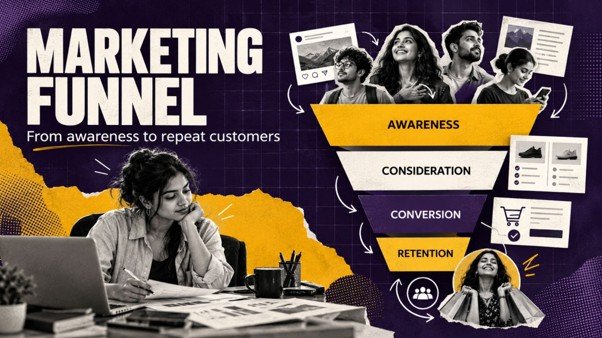
The marketing funnel is a simple model that helps marketers understand and plan this journey. It shows how a large group of people who become aware of your brand gradually narrows into a smaller group of paying customers, and ideally, loyal advocates.
This guide explains each funnel stage, the content and channels that fit them, the metrics to track and a step-by-step process to build a funnel that actually converts. Funnel planning sits within the “structure planning” pillar of Organic Performance Marketing.
What Is a Marketing Funnel?
A marketing funnel is a framework that maps the stages a person moves through, from first discovering a brand to becoming a customer and beyond. It is shaped like a funnel because many people enter at the top, and fewer move through each stage.
Understanding the funnel helps you: – Create the right content for the right moment – Spot where potential customers drop off – Allocate budget more effectively – Measure performance at each stage
The Classic Funnel Stages
Marketers often describe the funnel in three main parts, with two important stages after the sale.
1. Top of Funnel (TOFU): Awareness
Goal: Get discovered by people who have a problem you solve.
At this stage, people may not know your brand or even that a solution exists. They are searching for information, scrolling social media or reading content.
Content that fits: – Educational blog posts and guides – Short-form videos and reels – Infographics – Podcasts and YouTube videos – Social media posts addressing common problems
Channels: SEO, social media, YouTube, PR, influencer collaborations, awareness ads.
Metrics: Reach, impressions, website visitors, video views, new followers.
2. Middle of Funnel (MOFU): Consideration
Goal: Build trust and help people evaluate options.
People now understand their problem and are comparing solutions. They want proof, details and reassurance.
Content that fits: – Comparison guides and “how to choose” articles – Case studies and testimonials – Webinars and live sessions – Free guides, checklists or templates in exchange for an email (lead magnets) – Email nurture sequences
Channels: Email, retargeting ads, SEO for comparison keywords, webinars, WhatsApp communities.
Metrics: Engagement time, lead magnet downloads, email signups, returning visitors, email open and click rates.
3. Bottom of Funnel (BOFU): Decision
Goal: Turn interested prospects into customers.
People are ready to choose. They need clear offers, pricing, reassurance and an easy way to act.
Content that fits: – Product or service pages – Pricing pages – Free consultations, demos or trials – Limited-time offers – FAQs addressing final objections – Strong testimonials and guarantees with clear terms
Channels: Search ads for high-intent keywords, retargeting, sales calls, WhatsApp follow-ups, landing pages.
Metrics: Conversion rate, cost per lead, cost per acquisition, sales, revenue.
4. Retention
Goal: Turn first-time customers into repeat customers.
Tactics: Onboarding emails, usage tips, loyalty rewards, personalised offers, excellent support.
Metrics: Repeat purchase rate, churn, customer lifetime value.
5. Advocacy
Goal: Turn happy customers into promoters.
Tactics: Review requests, referral programmes, user-generated content, community building.
Metrics: Reviews, referrals, social mentions, net promoter score.
Funnel Example 1: Local Coaching Institute
• Awareness: Instagram reels with study tips; blog posts ranking for exam preparation queries
• Consideration: Free downloadable study plan in exchange for a WhatsApp number; results-focused case studies
• Decision: Free demo class booking page; limited early-bird batch offer
• Retention: Progress updates to parents; referral discounts for siblings and friends
• Advocacy: Toppers’ testimonial videos; Google reviews from parents
Funnel Example 2: D2C Skincare Brand
• Awareness: Ingredient education reels; influencer collaborations
• Consideration: Skin-type quiz collecting emails; detailed product comparison pages
• Decision: First-order discount; reviews with photos; easy UPI and COD checkout
• Retention: Replenishment reminders; loyalty points
• Advocacy: Photo review rewards; referral codes
Funnel Example 3: B2B Service Company
• Awareness: LinkedIn thought leadership; SEO articles on industry challenges
• Consideration: Downloadable reports; webinars; case studies
• Decision: Consultation booking; detailed proposals; client references
• Retention: Quarterly reviews; added services
• Advocacy: Co-authored case studies; referral partnerships
How to Build a Marketing Funnel Step by Step
Step 1: Define Your Audience and Goal
Start with research and personas. What does a successful customer journey end with: a purchase, booking, subscription or signed contract? See market research for marketers.
Step 2: Map the Current Journey
List how customers currently discover, evaluate and buy from you. Interview recent customers about their path.
Step 3: Identify Gaps and Drop-Off Points
Use analytics to see where people leave: high traffic but few leads, many leads but few sales, or many first purchases but few repeat buyers. Our marketing analytics for beginners guide explains how.
Step 4: Create Content and Offers for Each Stage
Fill gaps with stage-appropriate content. Many businesses have plenty of top-of-funnel posts but weak middle and bottom stages, or strong offers but no awareness content.
Step 5: Connect the Stages
Every piece of content should guide people to the next step: a blog post links to a free guide; the guide’s email sequence invites a consultation; the consultation leads to a proposal.
Step 6: Build Landing Pages and Automation
Create focused landing pages for lead magnets and offers, and set up email or WhatsApp automation to nurture leads consistently.
Step 7: Add Paid Amplification
Use ads strategically: awareness campaigns at the top, retargeting in the middle and high-intent search ads at the bottom. See Google Ads vs Meta Ads.
Step 8: Measure, Test and Optimise
Track metrics at every stage and run experiments to improve conversion between stages.
Funnel Metrics Cheat Sheet
| Stage | Key Metrics |
| Awareness | Reach, impressions, new visitors, views |
| Consideration | Engagement, leads, email signups, returning visitors |
| Decision | Conversion rate, CPL, CPA, sales |
| Retention | Repeat purchase rate, churn, CLV |
| Advocacy | Reviews, referrals, mentions |
Common Funnel Mistakes
• Asking for the sale too early from cold audiences
• Neglecting the middle of the funnel, leaving interested people without nurturing
• Disconnected content with no clear next step
• Ignoring retention, even though repeat customers are often cheaper to serve
• Measuring only the final conversion instead of stage-to-stage movement
• Using the same message for every stage
Funnels in the OPM Engineer Programme
Structure planning, which includes funnel and website architecture, is the fourth pillar of VisionaryCue’s OPM Engineer programme. It connects strategy to communication, design and development, ensuring every marketing asset has a clear role. Learn more in the curriculum, or read our digital marketing strategy guide to see how funnels fit into the bigger plan.
Funnel Automation Ideas for Small Businesses
Automation keeps your funnel working even when you are busy. Practical examples include:
• Welcome sequences: when someone downloads a free guide, send three to five emails or WhatsApp messages over two weeks, introducing your brand, sharing helpful tips and inviting them to the next step.
• Abandoned enquiry follow-up: if a visitor starts but does not complete a booking or form, send a gentle reminder.
• Post-purchase onboarding: after a sale, send usage tips, care instructions or a welcome guide.
• Review requests: a few days after service or delivery, ask for a review with a direct link.
• Re-engagement: contact customers who have not purchased in a while with a relevant offer or update.
• Lead routing: send high-intent leads directly to a salesperson’s WhatsApp or CRM.
Start with one or two automations that address your biggest drop-off point, measure the impact and add more gradually.
How to Spot Your Biggest Funnel Leak
Calculate conversion rates between each stage to see where the largest drop happens. For example:
• 10,000 people reached
• 600 visited the website (6% of reach)
• 60 submitted an enquiry (10% of visitors)
• 12 became customers (20% of enquiries)
If competitors or benchmarks suggest your website conversion rate could be higher, the landing page might be the leak. If enquiries rarely turn into customers, follow-up speed or sales conversations might be the issue.
Fixing the biggest leak usually delivers more growth than adding more traffic at the top. This is one of the most valuable mindsets a marketer can develop.
Funnel Content Planning Template
Use this simple template to plan funnel content for any business:
| Stage | Customer Question | Content Idea | Channel | Next Step |
| Awareness | “Why does my back hurt after work?” | Reel: three posture fixes | Link to blog | |
| Consideration | “Physiotherapy or painkillers?” | Comparison blog post | Website / SEO | Free guide download |
| Decision | “Which clinic should I choose?” | Testimonials and consultation page | Website / Search ads | Book appointment |
| Retention | “How do I avoid pain returning?” | Exercise video series | Email / WhatsApp | Follow-up visit |
| Advocacy | “Who else could benefit?” | Referral offer | Refer a friend |
Filling a table like this for each persona quickly reveals missing content and weak connections between stages.
Funnels for Different Business Models
Funnels look different depending on the business:
• Low-cost impulse products: short funnels where a single ad can lead directly to purchase.
• High-value services: longer funnels with education, proof, consultations and follow-ups.
• Subscriptions: emphasis on onboarding and retention to reduce churn.
• B2B: multiple stakeholders, longer consideration and personalised outreach.
Design your funnel around how your customers actually decide, not around a generic template.
Funnels and Customer Experience
A funnel is not only a marketing diagram; it is a customer experience. Every stage should feel helpful rather than pushy. Fast replies, clear information, honest offers and respectful follow-ups make customers more likely to move forward and recommend you to others.
Your Action Checklist
Use this checklist to put the ideas in this guide into practice over the next few weeks. Tick each item off as you go, and revisit the list whenever you feel stuck or unsure what to do next:
• ☐ Map your current customer journey stage by stage.
• ☐ Calculate conversion rates between stages.
• ☐ Identify the biggest leak.
• ☐ Create one lead magnet for the middle of the funnel.
• ☐ Set up a simple welcome sequence.
• ☐ Add retargeting for website visitors.
• ☐ Ask every happy customer for a review.
• ☐ Review funnel metrics monthly.
Working through these steps consistently will turn the concepts in this article into real skills, measurable results and material you can proudly add to your portfolio.
A well-planned funnel turns occasional interest into steady, predictable growth for any business, whether it sells products, services or courses, and it gives marketers a clear map for every future campaign they plan.
Key Takeaways
• The funnel maps the journey from awareness to consideration, decision, retention and advocacy.
• Each stage needs different content, channels, messages and metrics.
• Most businesses have gaps in the middle of the funnel or in retention.
• Every piece of content should guide people to a clear next step.
• Measure movement between stages and optimise where people drop off.
Final Thoughts
A marketing funnel turns scattered marketing activity into a guided journey. By understanding each stage, creating the right content and offers, connecting them with clear next steps and measuring performance, you can convert more strangers into customers and more customers into advocates.
Want to learn how to plan funnels for real brands and clients? Explore the OPM Engineer timeline or book a free consultation.
Frequently Asked Questions (FAQs)
1. What is a marketing funnel?
A framework showing the stages people move through from discovering a brand to becoming customers and advocates.
2. What are TOFU, MOFU and BOFU?
Top of funnel (awareness), middle of funnel (consideration) and bottom of funnel (decision).
3. What is the difference between a marketing funnel and a sales funnel?
They overlap. Marketing funnels usually focus on attracting and nurturing prospects, while sales funnels focus on converting qualified leads into customers.
4. What content works best at the top of the funnel?
Educational, entertaining and problem-focused content such as blogs, reels, videos and social posts.
5. What is a lead magnet?
A free, valuable resource, such as a guide or checklist, offered in exchange for contact details.
6. Why do prospects drop out of the funnel?
Common reasons include unclear messaging, lack of trust, weak offers, poor landing pages or missing follow-up.
7. How do I measure funnel performance?
Track stage-specific metrics such as reach, engagement, leads, conversion rates, sales and repeat purchases.
8. Do small businesses need a marketing funnel?
Yes. Even simple funnels help small businesses guide customers and use limited budgets more effectively.
9. How do ads fit into a funnel?
Awareness ads reach new audiences, retargeting nurtures interested people, and high-intent search ads capture ready buyers.
10. Is the funnel still relevant with complex customer journeys?
Yes. Journeys are rarely linear, but the funnel remains a useful model for planning content and measuring progress.
11. What tools help build funnels?
Website builders, landing page tools, email and WhatsApp automation, CRMs and analytics tools.
12. Is funnel planning part of the OPM Engineer curriculum?
Yes. It is part of the structure planning pillar, one of nine pillars in the programme.