
Many business owners delay their website for months. They wait for the “perfect” logo, the “right” photos or a quieter week that never comes. Meanwhile, customers are searching on Google, comparing options and choosing competitors who are already online.
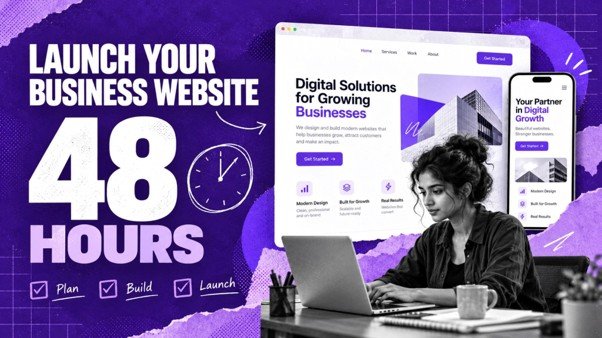
The good news is that a clean, professional, mobile-friendly business website does not need months of work. With the right preparation and a focused team, it can go live in 48 hours. At VisionaryCue, fast launches are a core part of how we work, and this guide explains exactly how the process works so you can plan your own quick launch.
Is a 48-Hour Website Actually Good Quality?
It is a fair question. “Fast” often sounds like “rushed.” The difference lies in scope and process.
A 48-hour website is not a 100-page portal with custom software. It is a focused website of roughly 3 to 6 pages designed to do one job very well: present your business clearly and turn visitors into enquiries. When the scope is tight and the team works from a proven framework, speed and quality can go together.
What makes a fast launch possible:
• A proven design system with pre-tested layouts that are customised to your brand
• A clear content brief collected before work begins
• Parallel work, where design, content placement and technical setup happen together
• Fewer, faster decisions, with feedback rounds kept short and specific
• Launch-first thinking, where version one goes live and improvements follow
What you should not expect in 48 hours: complex ecommerce with hundreds of products, custom booking engines, multi-language versions or app integrations. Those belong in a phased plan.
What You Need to Prepare Before Day One
The biggest cause of website delays is waiting for content. If you prepare these items before the project starts, you remove most of the friction.
Brand Assets
• Logo in high resolution (PNG with transparent background or SVG)
• Brand colours (if you have them) and any fonts you use
• Photos of your team, office, products or completed work
Business Information
• Business name, address, phone number, WhatsApp number and email
• Working hours
• Google Maps location
• Social media links
Page Content
• A short “About Us” story: who you are, how long you have been in business, what makes you different
• List of services or products with a few lines on each
• Three to five customer testimonials
• Any certifications, awards or client logos
Domain and Access
• Your domain name (or ideas if you have not bought one yet)
• Access to hosting, if you already have it
Do not worry if your content is rough. A good team will polish it. What matters is that the raw material exists.
The 48-Hour Launch Process, Hour by Hour
Here is how a fast website project typically runs.
Hours 0–4: Discovery and Planning
The project starts with a short discovery call. We confirm your goals, target customers, the main action you want visitors to take (call, WhatsApp, form, visit) and the page structure. A sitemap is agreed, usually something like:
1. Home
2. About
3. Services
4. Gallery or Portfolio
5. Contact
Hours 4–16: Design and Layout
Using a proven layout system, the designer builds your homepage first because it sets the visual direction. Colours, typography and imagery are matched to your brand. Inner pages follow the same system, which keeps the design consistent and saves time. This is where strong UI/UX design principles matter: clear headlines, obvious buttons and logical flow.
Hours 16–28: Content and Functionality
Your content is placed, edited for clarity and structured for search engines. Functional elements are added:
• Contact forms connected to your email
• Click-to-call and WhatsApp buttons
• Google Maps embed
• Social links
• Testimonials section
Hours 28–36: SEO and Technical Setup
Even a fast website should be built to rank. This stage includes:
• Page titles and meta descriptions
• Clean URLs and heading structure
• Image compression and alt text
• SSL certificate (HTTPS)
• Google Analytics setup
• Google Search Console submission
Our on-page SEO checklist for new websites explains each item in detail.
Hours 36–44: Review and Revisions
You review a live preview on your phone and laptop. Feedback is collected in one consolidated list, and changes are made quickly. Clear, single-round feedback is the secret to staying on schedule.
Hours 44–48: Testing and Launch
The site is tested across devices and browsers. Forms are checked, links are verified and loading speed is reviewed. Then the website goes live on your domain.
Common Mistakes That Slow Down a Fast Launch
Even with a great team, some habits add days to a project:
Waiting for perfect photos. Launch with good-enough images and replace them later. A website with decent photos that is live beats a perfect one that does not exist.
Feedback from too many people. If five family members and partners all review the site separately, you get conflicting opinions. Nominate one decision-maker.
Adding new features mid-project. “Can we also add a booking calendar?” is a great phase-two idea. Adding it mid-way resets the timeline.
Rewriting content endlessly. Your website text can be edited anytime after launch. Aim for clear and accurate, not perfect.
Domain confusion. Make sure you know who owns your domain and that you can access the account.
What a 48-Hour Website Should Still Include
Speed should never mean skipping the basics. Even the quickest launch should deliver:
• Mobile-responsive design that looks right on all screen sizes (most of your visitors will be on phones; read why mobile-first design matters)
• Fast loading pages, with compressed images and lightweight code
• HTTPS security with a valid SSL certificate
• Clear calls to action on every page
• Basic SEO setup so Google can understand and index your site
• Analytics so you can measure visitors and enquiries
• Contact options that work: forms, phone, WhatsApp
If a quick-launch provider cannot promise these, the speed is not worth it.
After Launch: Your First 30 Days
Going live is the beginning, not the end. Here is what to do in the first month:
Week 1: Share It Everywhere
Add the website link to your Google Business Profile, Instagram bio, WhatsApp Business profile, email signature and visiting card.
Week 2: Collect Reviews
Ask happy customers to leave Google reviews. Add the best ones to your website testimonials section. Reviews help both trust and local SEO.
Week 3: Check Your Analytics
Look at how many people visited, which pages they viewed and where they came from. Our guide to Google Analytics 4 setup for small businesses shows what to track.
Week 4: Plan Phase Two
Based on real customer behaviour, decide what to add next: a blog, more service pages, an online booking system or a small store.
When 48 Hours Is Not the Right Timeline
A fast launch is perfect for many businesses, but not all. Choose a longer timeline if:
• You need a full ecommerce store with many products, variants and payment options (see our ecommerce solutions)
• You are building a web application with user accounts and dashboards
• Your industry has compliance requirements that need legal review
• You are going through a full rebrand and the visual identity is not ready
• You need custom integrations with ERP, CRM or third-party systems
In these cases, a phased approach works well. Launch a simple version quickly to establish your online presence, then build the complex system in the background.
Who Benefits Most from a 48-Hour Website?
Fast launches are especially useful for:
• New businesses that need credibility from day one
• Local service providers such as plumbers, electricians, salons, tutors, caterers and repair shops
• Consultants and freelancers who need a professional portfolio
• Event-driven businesses launching before a festival season, exhibition or product drop
• Businesses with an outdated site that needs a quick refresh while a larger redesign is planned
• Startups testing an idea before investing heavily
If your current website is old and embarrassing, a quick refresh can buy you time. Read the signs your website needs a redesign to decide.
How Much Does a 48-Hour Website Cost?
Because the scope is focused, fast-launch websites are usually among the most affordable options. VisionaryCue’s websites start at ₹2,700 onwards, and every plan includes our essential Digital Marketing & SEO package at no extra cost. For a full picture of pricing across website types, see our guide to website development cost in India or check our pricing.
Fast Website vs DIY Builder: Which Gets You Online Better?
Some owners consider building a site themselves over a weekend with a drag-and-drop builder. It is possible, but compare the two honestly.
Time.
A DIY build looks fast, but most first-timers spend many evenings choosing templates, fighting with layouts and figuring out how to connect a domain. A professional 48-hour launch requires a couple of hours of your time for the brief and the review.
Design quality.
Templates look polished in demos because they are filled with professional photography and carefully written copy. Once your real content goes in, layouts often break or look generic. A designer adapts the layout to your content, not the other way around.
SEO and speed.
Builders handle some basics, but page titles, heading structure, image compression and analytics are frequently left untouched by DIY users. These details decide whether customers ever find you.
Ownership and flexibility.
Some builders lock your site into their platform. Moving later can mean rebuilding from scratch. A professionally built WordPress or custom site stays yours.
Cost over time.
Builder subscriptions continue every month for as long as the site exists. A one-time professional build on affordable hosting is often cheaper over two or three years.
DIY can work for a hobby project. For a business that depends on enquiries, a quick professional launch usually delivers better results for the time invested.
Real Examples of Fast-Launch Use Cases
To make this practical, here are situations where a 48-hour website changes the outcome for a business:
• A caterer before wedding season needs a menu, gallery and enquiry form live before families start booking.
• A new physiotherapy clinic opens next week and wants patients searching locally to find a credible site, not just a map pin.
• A consultant attending a trade show needs a portfolio link to print on brochures and share with leads.
• A small manufacturer bidding on a tender wants a professional company profile online before the evaluation committee checks.
• A boutique planning a festival sale wants a simple catalogue page with WhatsApp ordering before Diwali traffic arrives.
In each case, the cost of waiting a month is higher than the cost of launching a focused site now.
How to Brief Your Developer for Maximum Speed
The quality of your brief determines the speed of your launch. A strong brief answers four questions in a few lines each:
1. Who are you?
One paragraph about your business, your experience and your location.
2. Who do you serve?
Describe your typical customer: age, location, needs, and what worries them before they buy.
3. What do you want visitors to do?
Choose one primary action. “Call us” or “WhatsApp for a quote” is better than five competing buttons.
4. What do you like?
Share two or three websites whose look and feel you admire, and say what you like about each.
Add your content folder and access details, and your developer has everything needed to move fast. A brief like this takes less than an hour to write and can save days of back-and-forth messages.
Final Thoughts
A professional business website in 48 hours is realistic when the scope is clear, content is ready and the team follows a proven process. You do not need to wait months to look credible online. Launch a strong first version, learn from real visitors and improve it month by month.
Ready to go live this week? Get in touch with VisionaryCue or explore our web design and development service. Share your details, and we will map out your 48-hour launch plan.
Frequently Asked Questions (FAQs)
1. Can a website really be built in 48 hours?
Yes. A focused business website of around 3 to 6 pages can be designed, built, tested and launched in 48 hours when content is ready and the team uses a proven process.
2. What type of websites can be launched in 48 hours?
Business websites, portfolios, landing pages, local service websites and small brochure sites are ideal. Large ecommerce stores and custom applications need longer timelines.
3. Will a 48-hour website be mobile-friendly?
It should be. Every VisionaryCue website is fully responsive and tested on phones, tablets and desktops before launch.
4. Is SEO included in a fast website launch?
Basic SEO, including meta titles, descriptions, heading structure, image alt text, SSL and Google Analytics setup, should be part of every launch, regardless of speed.
5. What do I need to provide to start?
Your logo, business details, service list, a short about-us text, photos and domain details. Rough content is fine; it can be polished during the build.
6. What if I do not have a domain name?
Your developer can help you choose and register a suitable domain. Make sure it is registered in your name so you retain ownership.
7. Can I make changes after the website goes live?
Absolutely. Websites can be updated anytime. Many improvements are best made after launch based on real visitor behaviour.
8. How many revisions are included?
This depends on the plan. Fast launches work best with one consolidated round of feedback, followed by minor tweaks after launch.
9. Will the website be secure?
Yes. A professional launch includes an SSL certificate (HTTPS), secure form handling and up-to-date software.
10. Can I add a blog or store later?
Yes. Starting simple and adding a blog, booking system or online store in phase two is a smart, budget-friendly approach.
11. Does a fast website rank on Google?
A well-structured site can be indexed quickly, but rankings depend on content, competition, reviews and ongoing SEO effort over time.
12. What happens if I miss sending content on time?
The timeline shifts accordingly. The 48-hour clock usually starts once all essential content and access details are received.
13. Is a 48-hour website cheaper than a regular website?
Usually, yes, because the scope is focused. VisionaryCue websites start at ₹2,700 onwards.