How to Write a Brand Positioning Statement (With Templates and Examples)
Ask five people in a growing company “why should a customer choose us?” and you will often hear five different answers. That is a positioning problem. A brand positioning statement solves it by putting the answer in one clear, agreed sentence that guides your website, ads, sales pitch and product decisions.
This guide shows you how to write a positioning statement step by step. You will get fill-in templates for B2C and B2B brands, illustrative examples, a checklist to test your draft and the mistakes that make positioning statements useless.
What Is a Brand Positioning Statement?
A brand positioning statement is an internal sentence (or short paragraph) that defines:
• Who your brand is for.
• What need it meets.
• Which category it competes in.
• What main benefit it delivers.
• What makes it different from alternatives.
• Why customers should believe it.
It is a strategic tool, not a slogan. Customers may never read it word for word. Your team, designers, copywriters and agencies use it to make consistent decisions.
If you need the bigger picture first, our post on the five key steps to effective brand positioning explains the overall process. This article focuses on writing the statement itself.
Positioning Statement vs Mission, Tagline and Value Proposition
These terms are easy to confuse. The table clarifies the difference.
| Term | Purpose | Audience | Example form |
| Mission statement | Why the company exists and what it does daily | Team, investors, public | “To make healthy food affordable for every family.” |
| Positioning statement | Where the brand competes and why it wins | Internal team and partners | “For X who need Y, Brand is the Z that…” |
| Value proposition | The main benefit promised to a customer | Customers | “Get fresh meals delivered in 30 minutes.” |
| Tagline | A short, memorable expression of the brand | Customers | “Fresh. Fast. Family-friendly.” |
The positioning statement comes first. The value proposition and tagline should be derived from it.
The Classic Positioning Statement Template
The most widely used template looks like this:
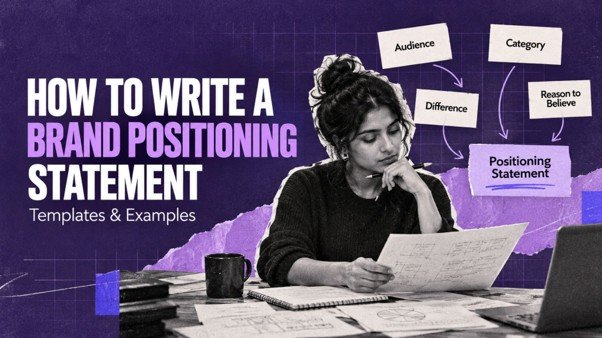
For [target audience] who [need or problem], [brand name] is the [category or frame of reference] that [primary benefit]. Unlike [main competitor or alternative], we [key differentiator], because [reason to believe].
Each bracket has a job:
• Target audience: a specific group, not “everyone”.
• Need: the problem or desire that triggers a purchase.
• Category: what customers will compare you with.
• Primary benefit: the most important outcome, not a list of features.
• Alternative: what customers would use if you did not exist.
• Differentiator: what you do that the alternative does not.
• Reason to believe: proof that makes the claim credible.
How to Write a Brand Positioning Statement in 6 Steps
Step 1: Define a Narrow Target Audience
Start with your best current customers, the ones who buy quickly, stay longest and refer others. Describe them by situation and need, not only demographics. “Owners of independent cafés in Delhi NCR who want more weekday footfall” is far more useful than “small businesses”.
Step 2: Identify the Real Need
Interview customers and read reviews. Ask what problem pushed them to look for a solution. You will often find the true need is different from what you assumed. A customer buying accounting software may really want “to stop worrying about GST deadlines”.
Step 3: Choose Your Category Carefully
The category tells customers what to compare you with. Choosing it is a strategic decision:
• An existing category (“digital marketing agency”) is easy to understand but crowded.
• A narrower sub-category (“integrated brand and growth agency for founder-led brands”) is clearer and easier to own.
• A completely new category is hard to explain and expensive to build.
Most growing businesses do best with a focused sub-category.
Step 4: Pick One Primary Benefit
Teams often want to include every advantage. Resist. Choose the one benefit your target audience values most and that you deliver better than alternatives. Everything else becomes a supporting message.
Step 5: Name the Alternative and Your Difference
Look at what customers actually use instead of you. Our guide to competitive analysis in digital marketing shows how to map this. Then state your difference in plain words. “Better quality” is not a difference. “Every order is checked by a certified technician before dispatch” is.
Step 6: Add a Reason to Believe
Proof turns a claim into a credible position. Reasons to believe can include process details, expertise, certifications, technology, guarantees you can honour, review themes or measurable product features. Never invent proof. If you do not have proof yet, that is a signal to build it.
Brand Positioning Statement Examples
The examples below are illustrative, written for fictional brands to show how the template works in different industries.
B2C Example: Skincare Brand
For young professionals in Indian cities who want simple skincare that suits humid weather, LeafLab is the minimalist skincare range that keeps skin clear with three-step routines. Unlike multi-step international brands, every product is formulated and tested for Indian climates, because our formulations are developed with dermatologists who treat Indian skin types.
B2B Example: Logistics Software
For operations heads at mid-sized D2C brands who struggle with late deliveries, ShipSure is the delivery management platform that cuts failed deliveries through smart courier allocation. Unlike single-courier tools, we compare multiple courier partners for every order, because our system uses each courier’s past performance by pin code.
Service Business Example: Interior Studio
For apartment owners in Noida and Gurugram who want premium interiors without delays, Studio Nine is the interior design studio that delivers on the agreed date. Unlike freelancers who manage work informally, we run every project on a fixed weekly schedule shared with the client, because our in-house project managers track every stage.
Local Business Example: Café
For remote workers in Sector 62 who need a reliable place to work, Brew & Build is the work-friendly café that offers fast Wi-Fi, quiet zones and power at every table. Unlike typical cafés, we are designed for long work sessions, because our layout and menu were planned around working professionals.
Alternative Positioning Statement Templates
The classic template does not suit every brand. Try these variations:
Short form (one line):
[Brand] helps [audience] [achieve outcome] by [unique approach].
Problem-led form:
[Audience] struggle with [problem]. [Brand] solves this with [solution], so they can [outcome], unlike [alternative].
B2B outcome form:
For [role] at [company type] responsible for [goal], [Brand] is the [category] that [measurable outcome], unlike [alternative], because [proof].
Positioning Strategies to Choose From
Before writing, it helps to know which type of position you are aiming for. Most brands compete on one of these bases:
| Positioning basis | What you claim | Example angle |
| Audience | “Built specifically for X” | Software only for independent pharmacies |
| Problem | “The best way to solve Y” | The fastest way to file GST for freelancers |
| Benefit | “The outcome you get” | Clear skin in humid weather |
| Price/value | “Best value for the quality” | Premium interiors at fixed, transparent prices |
| Quality | “The highest standard” | Every product lab-tested twice |
| Experience | “How it feels to work with us” | One dedicated manager from brief to delivery |
| Expertise/heritage | “We know this best” | 20 years in industrial packaging |
You can combine two bases, such as audience plus benefit, but avoid trying to own all of them. The more you claim, the less people remember.
Running a Positioning Workshop
If several people need to agree, run a short workshop:
1. Share evidence first. Present customer quotes, review themes, win/loss reasons and a competitor map. Positioning should start from facts, not opinions.
2. Draft individually. Ask each participant to fill in the template on their own. This avoids the loudest voice deciding.
3. Compare and cluster. Put all drafts side by side and group similar answers for each bracket.
4. Debate the hard choices. Usually the audience and the primary benefit cause the most discussion. Settle these first.
5. Write one combined draft. Then test it against the checklist below.
6. Sleep on it and validate. Show the draft to two or three trusted customers before finalising.
A focused two-to-three-hour session is usually enough for a small business, provided the research is ready beforehand.
How to Test Your Positioning Statement
Use this checklist before you finalise:
• Specific: Could a competitor use the same sentence? If yes, it is too generic.
• Relevant: Does the benefit matter to the audience, based on real customer feedback?
• Credible: Is there proof for every claim?
• Ownable: Can you defend this position for several years?
• Simple: Can a new employee repeat it after reading it once?
• Useful: Does it help you decide what to say no to?
Also test it in the market. Rewrite your homepage headline or an ad around the positioning and track response for a few weeks.
Common Positioning Statement Mistakes
1. Trying to target everyone. A broad audience makes every other part of the statement vague.
2. Listing features instead of benefits. “AI-powered dashboards” is a feature. “Know your daily sales in one glance” is a benefit.
3. Using buzzwords. “Innovative”, “world-class” and “solutions” add no meaning.
4. Copying competitors. If your statement sounds like the market leader’s, you will lose on budget.
5. No reason to believe. Claims without proof are ignored by customers and by your own team.
6. Writing it and filing it away. A positioning statement only works if it guides real decisions. Our article on branding mistakes that cost you clients shows how inconsistency undoes positioning work.
How to Use Your Positioning Statement
Once agreed, put the statement to work:
• Website: derive the homepage headline and subheadline from it.
• Sales: build your pitch and objection handling around the differentiator and proof.
• Ads: test creative angles that dramatise the primary benefit.
• Content: plan blog and social topics around the audience’s need.
• Product: prioritise features that strengthen your position.
• Hiring and onboarding: help new team members explain the business consistently.
VisionaryCue’s brand communication service turns positioning into messaging frameworks, brand voice and website copy, so the statement shows up consistently across every channel.
Conclusion
A brand positioning statement is one of the shortest and most valuable documents a business can create. Define a narrow audience, identify the real need, choose your category, focus on one primary benefit, name the alternative you replace and back it all with proof. Then test it, refine it and use it to guide every message.
When your positioning is clear, customers understand you faster and your marketing budget works harder.
Need an objective view of your positioning? VisionaryCue combines market and competitor analysis with brand strategy to define a position you can own. Get in touch to discuss your brand.
Frequently Asked Questions
What is a brand positioning statement?
A brand positioning statement is a short internal statement that defines who your brand serves, what need it meets, which category it competes in, its main benefit, how it differs from alternatives and why people should believe it. It guides messaging, design and marketing decisions so the brand communicates consistently.
How long should a positioning statement be?
Most positioning statements are one to three sentences, usually between 30 and 60 words. The goal is clarity, not length. If your statement needs a full paragraph to explain itself, the positioning is probably still too broad or trying to include too many benefits and audiences.
Is a positioning statement the same as a tagline?
No. A positioning statement is an internal strategic tool that explains where and how the brand competes. A tagline is a short, public-facing phrase designed to be memorable. A good tagline is usually inspired by the positioning statement, but it does not need to repeat all of its parts.
Who should write the brand positioning statement?
Founders or leadership should own it, with input from sales, customer support and marketing, because these teams hear customer language daily. An external strategist can add objectivity, research and facilitation, especially when internal opinions differ or the business is entering a new market or category.
How do you write a positioning statement for a B2B company?
Name the specific role and company type you serve, the business goal or problem they own, your category, a measurable outcome you deliver, the alternative they use today and proof such as process, integrations or expertise. B2B statements should reflect how buying committees evaluate risk and return.
How often should a positioning statement change?
Positioning should be stable for several years, because changing it often confuses customers. Review it annually, and revise it when you enter a new market, change your target customer, launch a significantly different product or when competitors move into the same position and you lose differentiation.
What makes a positioning statement strong?
A strong statement is specific to one audience, focuses on a benefit customers truly value, names a believable difference, includes proof and could not be used by a competitor without changes. It should also be simple enough for any employee to understand and repeat after reading it once.
Can a small business have a positioning statement?
Yes, and small businesses often benefit most. With limited budgets, a clear position helps a café, clinic, studio or service firm stand out locally, focus marketing spend on the right customers and explain its value quickly on Google Business Profile, social media and the website.
What is the difference between positioning and differentiation?
Differentiation is what makes you different from competitors. Positioning is the broader choice of audience, category and benefit within which that difference matters. A difference only becomes valuable when it is relevant to a chosen audience, which is why positioning includes differentiation but goes further.
How do I know if my positioning is working?
Look for practical signals: prospects understand your offer faster, sales cycles shorten, more leads are a good fit, website conversion rates improve after messaging changes and customers repeat your key benefit in reviews. Branded search growth and stronger referrals are also good long-term indicators.